
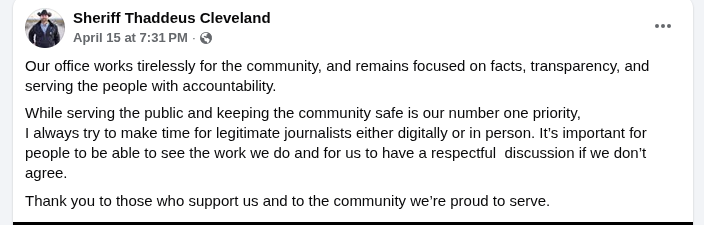
Over the past few days David Flash, the VP of Marketing at K&M Steam Cleaning and blogger bigbendtimes.com, has been engaging with Sheriff Thaddeus Cleveland on Facebook. The interactions have been strange to say the least. After the Sheriff posted about storms in the county last week, Flash responded:

Next, the Sheriff posted a video with the opening text:
Side note: If you find our reporting useful, please consider donating! https://www.gofundme.co/f/support-local-journalism-support-big-bend-times
David Flash responded with his Texas Reporter blogging account on FB and it was quite odd. David Flash, while traveling maybe in Paris, posted 8 responses at the top level on this post. And insane amount of BS. Please excuse our language. We copied the text from those 8 replies and it is… I shit you not, 4,850 words. If you click on Show Comments on those 8 replies, it’s mostly him with a similar number of posted words.
This is what’s called Flooding the Zone. You have to realize, Sheriff Thaddeus Cleveland, as an elected official, cannot block Flash or delete his comments. It’s a First Amendment Thing. So if there is a good conversation going on about Flash and his silliness on a public official’s FB, Flash can go on there and copy and paste a ton of stupid stuff in a bunch of different responses, and it just stays there. You end up with a thread that is just tons of crap from Flash. Then other comments get harder to find and no one wants to deal with all of that. The engagement drops.
Always watch out for the people that Flood The Zone. They often get into other things like buying fake followers, running dozens of accounts on FB and other platforms that they use to make it seem like they have more traction than they do. I mean, we aren’t saying we know anyone is doing this, we are just saying watch out for people who Flood The Zone.
Just for the sake of being complete, here are the FOUR THOUSAND EIGHT HUNDRED AND FIFTY WORDS:
Texas Reporter ·
Mary Ann Wagner Luedecke is not legitimate. She can’t even spell legitimate.
Mary Ann Luedecke Isn’t Just Unfit — She’s a Criminal in Office, and the Record Proves It
Mary Ann Luedecke is not just a judge who’s unqualified or biased. She is not just a public official who made bad decisions. She is, by her own actions, a criminal — abusing her position to file false charges, impersonate law enforcement, fabricate claims to prosecutors, and try to physically detain someone she had no authority to restrain.
That someone was me — a journalist who had filed legal claims against her and her county. Since then, Luedecke has launched a campaign of retaliatory misconduct so extreme, so well-documented, and so clearly unlawful that it’s time to stop being polite about it.
Below is a breakdown of the Texas criminal laws she has violated and the actions that match them — not hypothetically, but in full view of the public, backed by records, videos, transcripts, and her own words.
- Impersonating a Public Servant – Texas Penal Code § 37.11 (Third-Degree Felony)
“A person commits an offense if they impersonate a public servant with intent to induce another to submit to the person’s pretended official authority.”
Luedecke stood in a courthouse hallway yelling, “You’re detained! You’re detained!” in an effort to stop me from walking away. She is not a law enforcement officer. She has no authority to detain anyone. But she demanded compliance with what she knew was an illegal order — attempting to compel physical submission using the illusion of state power. That is the textbook definition of impersonating a public servant. - False Report to a Peace Officer – Texas Penal Code § 37.08
“A person commits an offense if, with intent to deceive, they knowingly make a false statement that is material to a criminal investigation.”
After failing to stop me, Luedecke tried to have me charged with evading detention — even though no lawful detention was in progress. She then escalated the retaliation further by filing false criminal charges against me, including baseless accusations of harassment and making threats. Her claims were not only untrue — they were contradicted by video evidence and physical impossibility. - Official Oppression – Texas Penal Code § 39.03
“A public servant acting under color of their office commits an offense if they intentionally subject another to mistreatment or deny them a right they know they’re entitled to.”
Luedecke used her position as a judge to try to punish me outside the bounds of law — ordering retaliatory warrants, coordinating with deputies behind the scenes, ignoring legally submitted filings, and fabricating court record entries to justify action. These aren’t clerical errors or misunderstandings. They are conscious acts of suppression and coercion, done under color of office, for personal and political reasons. - Obstruction or Retaliation – Texas Penal Code § 36.06 (Third-Degree Felony)
“A person commits an offense if they harm or threaten to harm another in retaliation for their participation in an official proceeding or for reporting misconduct.”
Luedecke’s entire campaign intensified after I filed civil claims against her and Jeff Davis County. From that point on, she retaliated: attempting illegal detention, pushing for false criminal charges, and lying to state prosecutors. She wasn’t acting as a neutral judicial officer. She was weaponizing her office to silence a journalist who filed a lawful complaint — a clear-cut case of criminal retaliation. - Tampering with a Government Record – Texas Penal Code § 37.10
“A person commits an offense if they knowingly make a false entry in a government record, or use a false record with the intent to defraud or harm.”
Luedecke approved court transcripts claiming I had “wholly failed to appear,” when she had received and returned filings I mailed in good faith. She even returned an appeal bond and payment I had sent — and then acted as though it had never been received. These records were later used to justify additional legal action against me. That is evidence tampering, and it’s a felony. - Filing False Criminal Charges
Luedecke gave a lengthy statement to prosecutors from the Texas Office of the Attorney General, in which she falsely accused me of multiple crimes. She portrayed herself as the victim of stalking and harassment — falsely claiming I went to her ranch, her child’s school, and a rodeo to follow her.
Let me be clear: I’ve never been to her ranch. I’ve never been near her child’s school. I never attended the rodeo she referenced. She fabricated these claims in an apparent effort to build a false pattern — twisting innocuous or unrelated things into something sinister.
When we obtained her statements in discovery, they weren’t just misleading — they were completely false, and many are disproven by hard evidence, including video. She didn’t misunderstand what happened. She made it up to try to get prosecutors to indict me. That is a criminal abuse of the justice system. - Unlawful Restraint by a Public Servant – Texas Penal Code § 20.02(c)(2)(A)
“A public servant who intentionally restrains another person without authority commits a felony.”
Luedecke’s public attempt to detain me — shouting at me to stop, demanding submission — was not a courtroom order or a judicial act. It was an illegal attempt to restrain a private citizen without authority. She used the trappings of her position to issue a demand that had no legal basis. Under Texas law, that is unlawful restraint, and it’s a felony when committed by a public official.
The Pattern Is Criminal
Mary Ann Luedecke didn’t make one mistake. She orchestrated a campaign: false statements, false records, false charges, false detainment attempts — all while cloaking herself in the authority of an office she long ago disqualified herself from holding.
If a private citizen pulled a stunt like this — made up charges, faked records, impersonated law enforcement, filed false reports, and tried to physically detain someone — they would already be behind bars.
Luedecke isn’t just unfit to serve. She is a danger to the community and to the rule of law. She must be removed from office, prosecuted under Texas law, and barred from holding any position of public trust again.
Justice cannot exist in Jeff Davis County as long as criminals control the courthouse.
• 4d
• Reply
• Edited
Texas Reporter ·
Mary Ann Luedecke, a crooked judge in Jeff Davis County, put my life in danger.
I’m Molly. And I matter.
I’m just a dog—but I’m not just anything to my dad, David Flash, publisher of Big Bend Times. He’s my person. My whole world.
One day, he didn’t come home. Not because he chose to leave me—but because Judge Mary Ann Luedecke abused her position and had him falsely arrested. She lied. She used the legal system to retaliate against someone who exposed her misconduct. And she didn’t care who she hurt in the process.
While he was locked up, someone came to let us dogs out. But they didn’t know I needed to be let back in.
I ended up alone. On a ranch. In the dark.
I could’ve been hit by a car trying to find him. I could’ve been bit by a snake. I could’ve gotten tangled in barbed wire or stepped on a cactus and never made it back.
I could’ve died. And it would’ve been her fault.
I was a rescue. Abandoned once already. I don’t run to strangers. I don’t have anyone but my dad.
When he got home and I wasn’t there to greet him, he panicked. He searched and searched until I finally made it home. We cried together that night.
Judge Luedecke didn’t just abuse the law. She endangered my life. She terrified an innocent animal.
All because she couldn’t handle the truth being reported about her.
I’m Molly. And what she did to me matters. • 3d
• Reply
Texas Reporter ·
A video recorded live at the Jeff Davis County Courthouse in October 2023 exposes a series of false claims made by Justice of the Peace Mary Ann Luedecke—claims that appear to be part of a broader, coordinated effort to criminalize the work of Big Bend Times publisher David Flash. The peaceful encounter was captured in full on video, yet Luedecke and others later described it as a dramatic incident involving threats, shouting, and even flight from justice—none of which occurred.
The footage shows Flash entering the public hallway of the courthouse to photograph a new sign posted outside Luedecke’s office. He never enters the office, never raises his voice, never pounds on any doors, and never behaves aggressively.
The door is first opened—and then closed directly in Flash’s face—by Luedecke’s assistant. Flash, visibly surprised but calm, continues filming. Despite this, Luedecke later claimed in a sworn statement to Texas Attorney General Special Prosecutor Geoff Barr:
“I opened the door. Asked Mr. Flash if I could help him. He began to scream at my clerk about why did you shut the door.”
That simply did not happen. Luedecke never opened the door, and Flash never screamed at anyone. The video proves it.
She also alleged that Flash mocked her after being asked to stop recording:
“He laughed and mockingly stated, ‘It’s already going out on Facebook Live.’”
That line is never spoken in the video.
Luedecke then falsely claimed she charged Flash with contempt and that he fled:
“Mr. Flash, I’m holding you for contempt, direct contempt in this court… Told him that three times. He turns and runs out of the courthouse… Flash runs to his car.”
Again, the video shows none of that. Flash walked—without urgency—out of the building, calmly narrating “You can’t detain me, ma’am” after Luedecke shouted “You’re detained!” from behind him. There was no contempt charge issued, no courtroom in session, and no legal basis for detention.
Weeks later, Flash received a “courtesy notice” from the court software system, indicating that a contempt warrant had been entered. Flash had not been informed of any ruling or hearing that would justify such a warrant. When confronted, Luedecke initially called it a mistake:
“The training exercise involving any data with your name was simply that… a training exercise… The exercise was deleted and nothing exists… Please disregard any courtesy notice you were sent.”
— Email from Judge Mary Ann Luedecke
But days later, her story shifted:
“We thought we had a case against you. The decision was made not to proceed and at that time the training exercise was deactivated.”
She never explained what that supposed “case” was. Through discovery, Flash is now learning that officials were attempting to manufacture criminal charges from the incident on video alone, including harassment, contempt, and even felony evading based on a peaceful departure from a public building.
“This wasn’t just one lie—it was a coordinated effort to invent charges from thin air,” Flash said.
Luedecke also included a school-related stalking allegation in her sworn statement, claiming she had personally seen Flash near a local school.
Flash flatly denies it. “I’ve never been near any school connected to her,” he said. “She claims she saw me, but there’s no record, no time, no detail—just another vague, baseless accusation. She saw ‘a man’ and decided it was me. That’s not evidence. That’s targeted defamation by a judge.”
Flash notes he has taken photos of Fort Davis ISD buildings from public streets on a couple of occasions for reporting purposes, but never of students and never involving anyone connected to Luedecke.
A related charge of “terroristic threat” has already been dismissed. The remaining harassment charge continues to be prosecuted by Barr, after County Attorney Glen Eisen was forced to recuse due to a pending tort claim filed by Flash.
Flash has filed four judicial conduct complaints against Luedecke, alleging a pattern of fabrications, misconduct, and misuse of office.
“They tried to create a paper trail to support lies—then blamed software, then blamed training, then claimed it was a case that fell apart,” Flash said. “None of that matches the video. And none of it should happen to anyone else.”
Big Bend Times will continue to report on the case and its broader implications for press freedom, judicial integrity, and government abuse of power in rural Texas. • 3d
• Reply
Texas Reporter ·
Jeff Davis County Justice of the Peace Mary Ann Luedecke is on tape fantasizing about assaulting journalist David Flash, admitting she now carries a gun everywhere she goes in case she sees him and feels threatened.
“Had I not been 70 years old,” she said during a sworn interview with state prosecutors,
“I’d pop him in the mouth and be done.”
“I’ve got a gun now. I carry it with me everywhere I go.”
Flash never threatened her. Video shows him calmly filming a public sign in a courthouse hallway, never entering her office, never yelling, and walking away without confrontation.
Despite that, Luedecke repeatedly claimed he was dangerous — even as the video shows she was the one yelling “You’re detained!” while Flash quietly responded, “You can’t detain me, ma’am.”
“She talks about violence, she carries a gun, and she lies — on the record,” Flash said.
“I told her I’m a vetted hospice and Meals on Wheels volunteer, a former Crime Stoppers board member. I asked her to stop treating me like a threat. Her response was: ‘Are you threatening me?’ I believe she’s dangerous.”
Luedecke is the key witness and complainant in the state’s ongoing harassment case against Flash — even though a separate terroristic threat charge has already been dropped and multiple elements of her story have been directly contradicted by video evidence.
Flash has filed complaints with the Texas Commission on Judicial Conduct, which has confirmed that the matter is under investigation.
“She created a fake story, triggered panic alerts, and now says she’s armed and ready to shoot if she sees me,” Flash said. “All because I exposed misconduct. This is not justice — it’s a threat to press freedom.”
Big Bend Times will continue reporting on the case, the state’s failure to act, and the ongoing danger of empowered officials with a record of lying and a license to carry.
• 3d
• Reply
Texas Reporter ·
In a recorded interview with prosecutors from the Texas Office of the Attorney General, Jeff Davis County Justice of the Peace Mary Ann Luedecke admitted she and other local officials actively discussed using Disney music to sabotage videos recorded by a local journalist—not to stop harassment, but to avoid public accountability.
The conversation, revealed in a January 2025 interview with OAG prosecutors, centered on how to prevent the public from hearing or seeing what officials said during encounters with Big Bend Times publisher David Flash.
According to Luedecke, the suggestion came from the Brewster County District Attorney’s office—not a law enforcement agency, but a prosecutor’s office.
“If he comes in here and he’s videotaping you, play something Disney and it’ll scramble it,” Luedecke recalled being told.
Rather than dismiss the idea, Luedecke and County Attorney Glen Eisen embraced it.
“I thought, really? That’s my best defense?” Luedecke said. “So I thought, okay, I’ll play Lady and the Tramp. Glenn Eisen said he was going to play Dumbo.”
The Truth About the Disney Music “Defense”
The suggestion reveals a fundamental misunderstanding of how copyright enforcement works. Playing Disney music during a video recording does not “scramble” footage. What it can do is trigger automated copyright detection systems on platforms like Facebook or YouTube. This may result in a copyright claim, muting of the audio, or demonetization—but only if the person posting the video had been trying to earn money from it.
That strategy has occasionally been used by individuals trying to disrupt livestreamers or so-called “First Amendment auditors,” a genre of content creators who seek out confrontations with public officials and depend on monetized content to drive views and income.
But that approach does not apply to Big Bend Times or its publisher.
Flash has repeatedly emphasized that he does not monetize video content and does not seek viral moments of confrontation. The inclusion of video in Big Bend Times reporting is for transparency and public documentation, not profit.
“They can play all the copyrighted music they want,” Flash said. “I don’t monetize any videos. I just record so they can’t lie about me later. If the public sees them trying to obstruct the press with Dumbo and Lady and the Tramp, that only shows who they really are.”
Manufactured Threats and False Narratives
The strategy to undermine Flash’s reporting did not stop with music.
Sheriff Ronnie Dodson of neighboring Brewster County personally told Flash about the internal chatter—after Flash legally purchased a firearm from Dodson’s gun store. Flash later referenced the purchase in a Facebook Live video, sharing what he had been told about the county’s behind-the-scenes efforts to stop him from reporting—along with the previous day’s attempt by Luedecke to have him falsely arrested.
That video showed Flash speaking calmly and professionally. He was not threatening anyone—only recounting events and protecting himself.
Still, county officials appear to have invested significant energy into casting Flash as a dangerous figure, rather than a credentialed journalist covering public meetings and courthouse operations.
Local Journalism, Not Provocation
Despite being mislabeled by local officials as a “First Amendment auditor,” Flash has consistently operated as a traditional journalist. He holds a Master of Science in Digital Audience Strategy from Arizona State University and founded Big Bend Times and Texas Reporter to deliver high-quality, independent reporting in undercovered areas of Texas.
He is not part of the auditor movement. He does not approach public officials seeking confrontation. But he does keep a camera rolling when reporting at government buildings—because, as this case demonstrates, public officials have shown a willingness to twist the truth.
“I never tried to ‘get’ anyone on video,” Flash said. “I just kept recording while doing my job so they couldn’t lie about what happened. Turns out, that was a good idea.”
Today, Big Bend Times continues to cover Jeff Davis County and the broader Big Bend region—even after Flash was forced to relocate for his safety. Though based elsewhere, he and his team continue to deliver more in-depth coverage of local government than any other outlet in the region.
And if officials still think playing Dumbo in the background is a strategy for avoiding scrutiny, it says far more about them than about the press they’re trying to silence. • 3d
• Reply
Texas Reporter ·
A recent incident at the Jeff Davis County Courthouse has ignited a debate surrounding First Amendment rights and government authority. Big Bend Times’ Editor & Publisher, David Flash, found his rights to record interactions with government officials and report on public matters impeded during an unexpected encounter with State Park Police Officer Jacob Barton and Judge Mary Ann Luedecke. This incident has raised crucial questions about the freedom of the press and content-based restrictions on recording public officials.
Flash’s visit to the courthouse initially began with explicit permission to document and broadcast from the empty, historic courtroom during a Facebook Live “walkthrough” of the historic building. His aim was to provide local and area enthusiasts with an inside look at the courtroom. After the Live, he also intended to get imagery for story about constables not executing misdemeanor warrants—a topic that had been discussed at a commissioner court meeting a month earlier.
However, as Flash entered the courthouse, he unexpectedly encountered Officer Barton in the presence of Judge Luedecke, the subject of his prior reporting. Flash proceeded to capture the scene and introduced the context of his visit, discussing his earlier interaction with Officer Barton and the recent negative reporting by Big Bend Times concerning the officer.
Initially, Judge Luedecke appeared cordial and accommodating. She acknowledged Flash’s intent to return to her office for a photograph and to discuss the constable story, responding with a polite “sounds good.” Flash concluded his first live video by touring the historic objects in the courthouse before returning upstairs to Judge Luedecke’s office.
In a surprising turn of events, as Flash resumed his recording in her office, the situation changed dramatically. Judge Luedecke instructed him to stop recording and directed her assistant to “push the button.” Flash interpreted this directive as an attempt to summon security or remove him from the premises.
This abrupt shift in behavior raised significant concerns about content-based restrictions on the freedom of the press and the right to document government interactions. Flash’s determination to continue recording stemmed from his commitment to providing transparency and accountability, particularly concerning Officer Barton’s alleged misconduct and the issues under scrutiny.
As the live broadcast concluded, questions lingered about the incident and the broader implications it held for First Amendment rights. The encounter at the Jeff Davis County Courthouse serves as a stark reminder of the ongoing debate surrounding freedom of the press and the importance of preserving the right to record government officials without fear of content-based restrictions. It underscores the need to uphold the public’s right to know, even in the serene landscapes of West Texas.
However, First Amendment considerations arise when you are openly recording the activities of police officers (or other public officials) carrying out their duties in public places. A number of U.S. Courts of Appeals have held that, in such circumstances, the First Amendment protects the right to record audio and video regardless of whether the police/officials consent. This constitutional right would override any state or federal laws that would otherwise prohibit such recording.
Currently, the following U.S. Courts of Appeals have recognized the First Amendment right to record the police and/or other public officials:
First Circuit (with jurisdiction over Maine, Massachusetts, New Hampshire, Puerto Rico, and Rhode Island): see Glik v. Cunniffe, 655 F.3d 78, 85 (1st Cir. 2011) (“[A] citizen’s right to film government officials, including law enforcement officers, in the discharge of their duties in a public space is a basic, vital, and well-established liberty safeguarded by the First Amendment.”); Iacobucci v. Boulter, 193 F.3d 14 (1st Cir. 1999) (police lacked authority to prohibit citizen from recording commissioners in town hall “because [the citizen’s] activities were peaceful, not performed in derogation of any law, and done in the exercise of his First Amendment rights[.]”).
Digital Media Law Project • 3d
• Reply
Texas Reporter ·
A recent visit to the Jeff Davis County Courthouse has become a point of contention, drawing the attention of local law enforcement. As the publisher of Big Bend Times, my objective on October 18 was to gather information for an upcoming story, adhering strictly to the rules and policies of the courthouse.
Upon being made aware of a new sign outside JP Judge Mary Ann Luedecke’s office, prohibiting audiovisual recording, I took extra care to respect its stipulations while also getting a photo of it from outside the newly-designated “no camera zone” for news reporting purposes.
Watch Here >> https://www.facebook.com/BigBendTimes/videos/296453246582787
However, despite my caution, I was met with a confrontational response from Judge Luedecke. To be clear, I did not enter her office during this visit, ensuring I remained within the boundaries set by the signage. Despite these precautions, I was taken aback by the unexpected and, in my view, overly aggressive approach from the judge.
For the record, I did capture our interaction, as I believed it to be in my best interest and a measure of ensuring transparency in such situations. My recording provides an unbiased account of the event and the unexpected aggression I faced.
I have always endeavored to uphold the highest standards of journalistic integrity and professionalism. In situations such as this, where I interact with public servants, I expect a similar level of mutual respect. The incident, particularly Judge Luedecke’s attempt to detain me, raises serious questions about the understanding and application of the law within the courthouse.
Sheriff Bill Kitts has been apprised of the situation and is currently reviewing the matter. While he acknowledges the judge’s right to issue certain directives, he is unclear about her authority to detain an individual under such circumstances. If concerns arise, there’s a possibility of the rangers being called in for a thorough investigation.
I’ve addressed my concerns directly to Judge Luedecke through a formal letter, expressing my hope for a more understanding and respectful relationship between the press and public officials in Jeff Davis County. It’s imperative for the community’s trust that these interactions uphold the rule of law and maintain an atmosphere of mutual respect.
Letter sent via email to JP Luedecke, cc Sheriff Kitts:
Re: Addressing Your Aggressive, Confrontational, Unwarranted Actions at the Courthouse on October 18
Dear Judge Luedecke,
I am writing to express my deep concern and disappointment regarding our encounter at the Jeff Davis County Courthouse on October 18. My intent, as always, was to fulfill my journalistic responsibilities and gather information for the Big Bend Times, with full respect for the courthouse’s established rules and policies.
While I became aware of the new sign outside your office prohibiting audiovisual recording and took care not to enter your office, I was surprised and disturbed by the confrontational tone of our interaction. I emphasize that at no point during my recent visit did I set foot inside your office, respecting the boundaries you set, even as I question their legality and appropriateness.
As a journalist, I always aim to approach my work with professionalism and integrity. I had hoped for a similar level of respect from a public servant in a position of authority. Your initiation of a dialogue, followed by what can only be described as harassment, was unexpected and, I believe, beyond the parameters of acceptable conduct for a judge. I am thankful that I had the foresight to record our interaction, providing undeniable proof of my conduct and the undue aggression I faced.
The trust between public officials and the community they serve is sacred. Your attempt to detain me, given that you do not possess the powers of a peace officer, was alarming and calls into question the proper understanding and application of the law within the very halls where justice should be upheld.
While I question the legality of your sign and its implications for First Amendment rights, I assure you that I will continue to respect it until it is addressed through the appropriate channels. It is worth noting that I diligently avoided entering areas where the sign’s restrictions apply. My commitment to upholding the law contrasts starkly with the actions I witnessed.
It is my sincere hope that you take this opportunity to reflect upon the incident and ensure that such confrontations, which erode the trust of the community, do not recur. For my part, out of concern for my safety and my professional reputation, I will continue to record my visits to the courthouse. I believe this will be beneficial for both parties, ensuring transparency and accuracy in our interactions.
I anticipate a future where interactions between the press and public officials in Jeff Davis County are defined by mutual respect, understanding, and adherence to the rule of law.
Sincerely,
David W. Flash • 3d
• Reply
Texas Reporter ·
Justice of the Peace Mary Ann Luedecke from Jeff Davis County has access to a 2023 Ram Cummins Diesel 4×4, equipped with extensive enhancements, bringing its estimated value to over $70,000. The truck’s initial cost was $53,250, with an additional $20,000 invested in features such as advanced emergency vehicle lighting, a robust grill guard, running boards, and specialized radio equipment.
County Judge Curtis Evans explained the vehicle’s availability, stating, “The Jeff Davis County Commissioners authorized the Justice of the Peace to use this truck and also other County Elected officials and County Employees may use this vehicle on an As Need Basis.”
In a broader regional context, this level of resource allocation appears highly exceptional. To gauge the norm, Big Bend Times reached out to other local justices of the peace—two in Presidio County and three in Brewster County. None of these officials have access to county vehicles, instead using their personal vehicles for all county-related duties. Justice Susana Gonzales from Marathon, Texas, confirmed this is standard practice in her remarks about recently receiving her first county-provided cell phone after years of service.
Amidst growing scrutiny, further questions about the Ram 3500 have emerged. Following unanswered initial inquiries, Big Bend Times submitted follow-up questions to county officials requesting additional transparency on the vehicle’s purchase, its users, and the specific county business justifications. Questions also covered the sources of funding for the truck, including whether Lone Star or Stonegarden grant funds were used, and whether this vehicle was the same one the EMS director had access to before her dismissal.
The lack of responses to these detailed follow-up questions has only heightened community calls for more transparency and accountability concerning this high-value county asset.llow-ups, responses from county officials remain pending. This lack of transparency has intensified calls from the community for clearer accountability regarding the use and justification of such a high-value county asset. • 3d
• Reply
